Planetarium Projector
This page shows, in 3D, the dumbbell-shaped optical projector that used to stand at the centre of a planetarium dome. The spheres at each end throw the stars; the cage between them carries the Sun, the Moon and the planets.
The machine holds no picture of the sky. Four moving axes — latitude, diurnal, annual and precession — compute when and where the sky is, mechanically. The tabs across the top switch between five ways of looking at it: showcase, mechanism, projection, exploded and sources. Open the page from the "Menu" button in the top-right of the screen, then choose "Planetarium Projector."
The five views
The page opens on Projection, which puts the dome, the star field and the machine in one frame, so what the instrument is for is clear straight away. Showcase is the machine itself — drag to turn it, and use the wheel (a pinch on a phone) to move closer. Mechanism names and reads the four moving axes; Exploded takes the machine apart; Sources gives the references and says what this model is not.
The readout at the bottom left always shows the instant the machine is currently computing, the angle of the latitude axis, and the sidereal time. Below it, play/pause, the three speeds (real time, 1 min/s, 1 h/s) and Jump to now are the same in every view: run the clock forward and the diurnal axis turns, whichever view is open.
At the right-hand end of the tab strip is an eye-shaped button, Hide the interface and watch the machine. Press it and the tabs, the panel and the readout all stand down, leaving the machine and its dome. The same button brings them back, and so does Esc.
Everything you do is written back into the address bar: the open view, the date, the latitude, the viewpoint, how far apart the machine is. So when the posture looks right, copy the URL — whoever opens it gets exactly that machine.
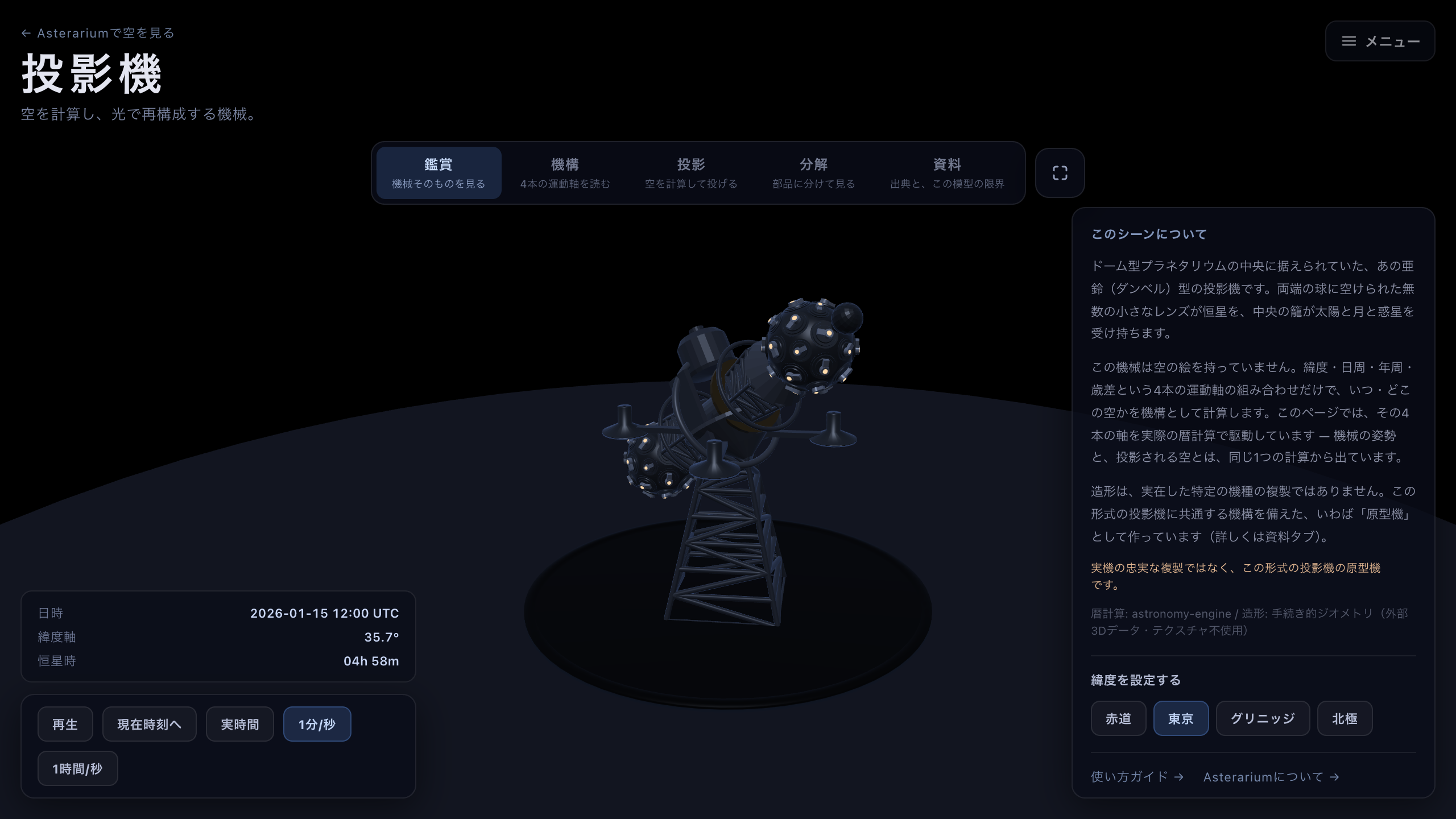
The showcase view. The spheres at each end throw the stars, the cage between them the Sun, Moon and planets — the shape that earned the name "dumbbell."
Reading the mechanism
Switch to Mechanism and names appear over the machine. They turn with it, and a name whose part has gone round the back disappears on its own. Click or tap one and a card opens describing that part.
The card is not a modal. The machine stays live behind it and the axes keep turning while you read, which is the point: you are meant to read about the diurnal axis while watching the diurnal axis turn. Close it with the × in its corner, or with Esc.
The selected part is kept in the address bar too (?p=). Moving to a view that draws no names — showcase, projection or sources — clears the selection, so a card describing something invisible is never left open.
The card's footer says that the note describes mechanisms common to this family of projectors, not the specification of any one real instrument. The machine on this page is an archetype rather than a replica, so no per-part reference is claimed; Open the Sources tab leads to the references for the page as a whole.
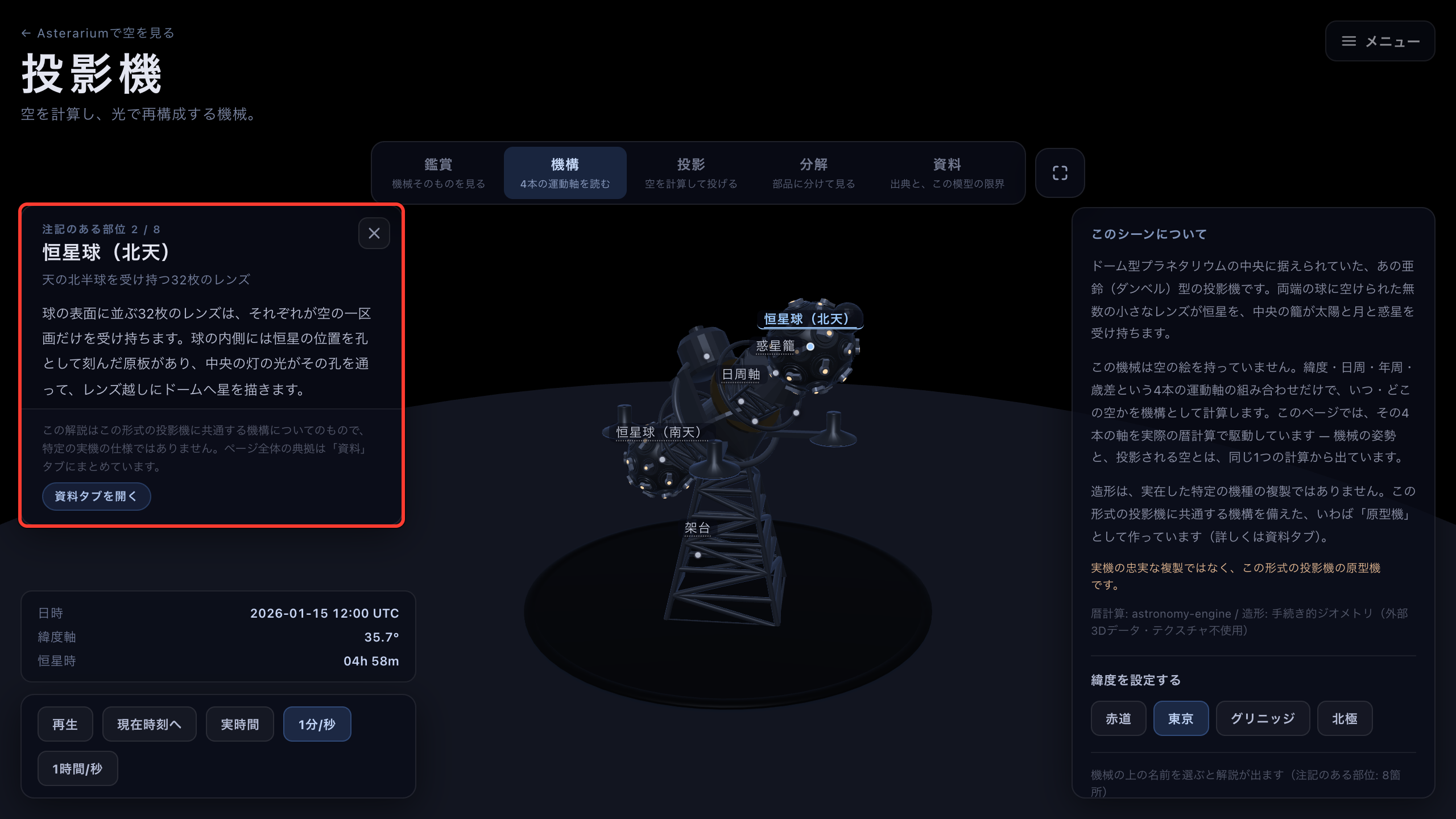
The northern star ball selected. The red frame marks its card — the machine keeps turning behind it while you read.
Making it compute a sky (Projection)
Projection is what the page is really for. A dome appears around the machine and the stars thrown by the spheres appear on the inside of it. Their positions come from real ephemeris, and the machine's posture and the sky it throws come out of one and the same calculation — change the latitude and the latitude axis tilts, and the sky tilts with it.
Choose a sky, at the bottom right, sets the instant (in UTC) and the latitude and longitude. The date can be typed straight into the field. Latitude is a slider rather than a set of buttons precisely so you can run it from the equator to the pole and watch the latitude axis rise. The latitude presets — Equator, Tokyo, Greenwich, North Pole — are in the bottom-right panel of the showcase, mechanism and exploded views.
Try From a seat. The camera descends into the dome and settles at a seated eye height, looking up (six metres south of the centre — the pedestal stands where the centre is). It is not a cut: the move takes a second or two, and throughout it the camera keeps whatever it was watching in frame as it turns. The machine puts you back outside with the instrument and its dome in view. (Both switch instantly if the device is set to reduce motion.)
In this view only, the readout gains the Sun's altitude. "Below the horizon" means night; a positive angle means day. If the sky looks wrong, look there first.
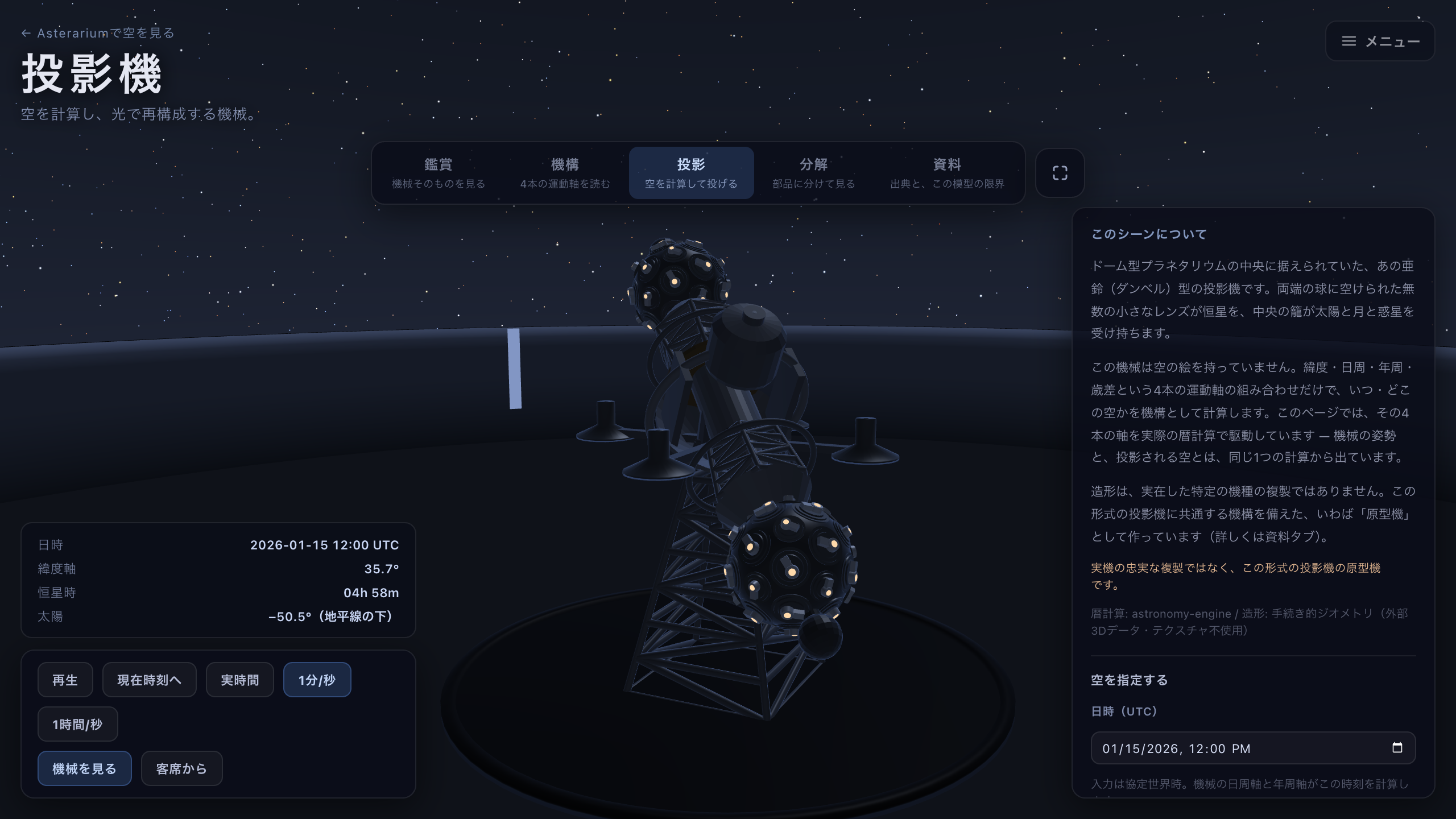
The projection view: the machine computing and throwing the sky over Tokyo at 21:00 JST on 15 January 2026.
Taking it apart
Opening the Exploded tab shows the machine already apart — a view called "exploded" that opened on an intact machine would just look broken. Pull the How far apart slider at the bottom left back to zero to reassemble it. The slider takes the keyboard too: focus it and nudge with the arrow keys.
The parts do not scatter at random. They leave in the order a fitter would take them off — covers, then the spheres, the rings, the cages, and the stand — so moving the slider slowly shows what is mounted on what.
Names stay up while the machine is apart, and each name travels with its part. A component floating on its own is exactly the one you cannot identify by looking at it, which is why the labels follow. How far apart is kept in the address bar (?x=).
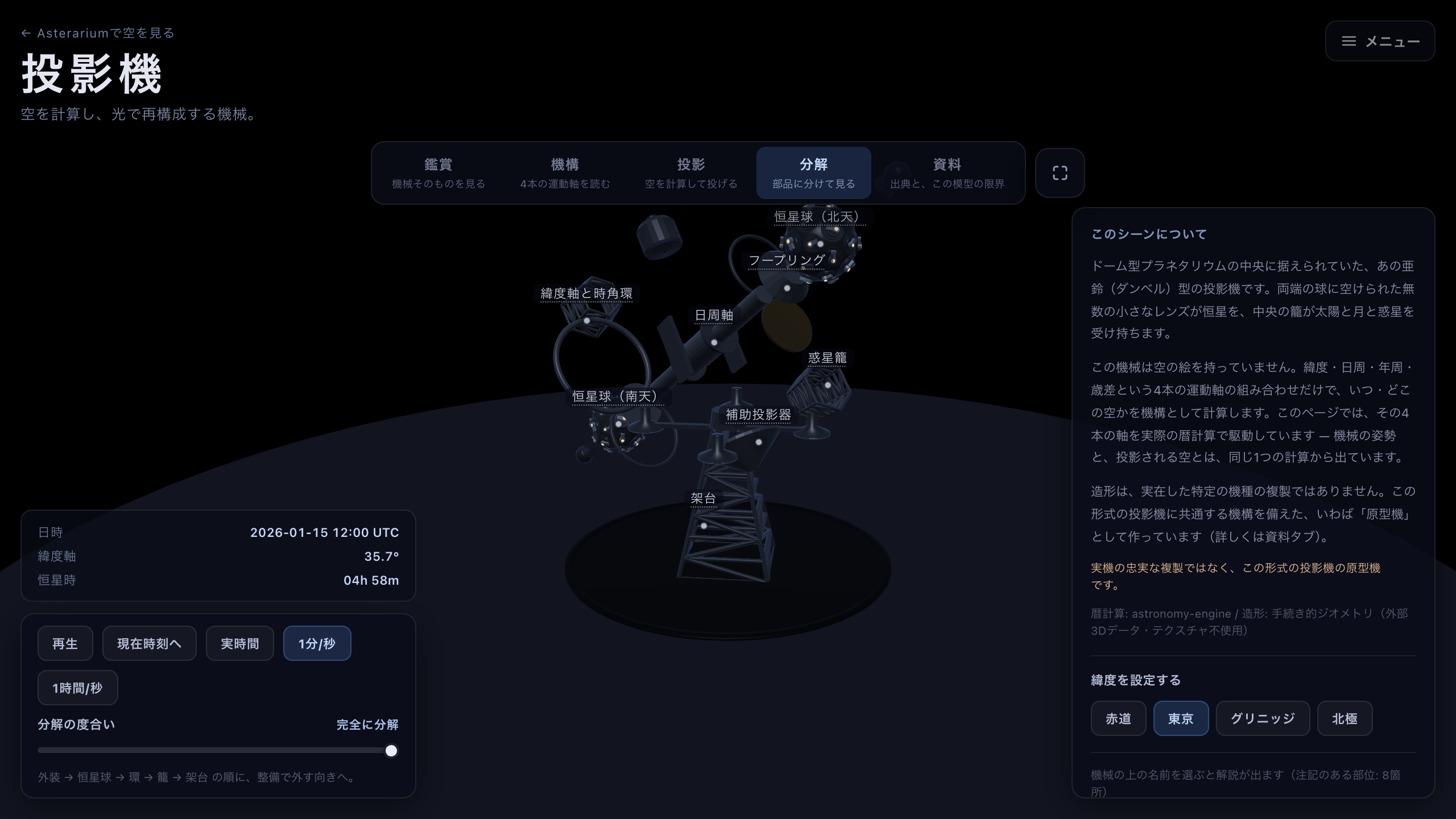
Fully apart. Covers, spheres, rings, cages and stand have each left the way a fitter would take them off.
Sources, and what this model is not
The Sources tab is something to read. Three cards trace where this kind of machine came from: the 1923 invention in Jena, the post-war rebuilding and the instrument still working at the Akashi Municipal Planetarium since it opened in 1960, and the domestic line that begins with Goto Optical's M-1 of 1959. Each card lists the references actually used to write it.
Below them, What this model is not sets out what the model does not attempt and what it changes on purpose: the star spheres' own parallax is not reproduced; the seated viewpoint carries a dome's own parallax (up to 33.2° near the horizon); the Sun is drawn larger than it really is; planets, the Moon and precession are out of scope as projections; two proportions were deliberately altered; and no counterweights were modelled. None of these are unfinished corners — each is a place where doing the literal thing would have broken something else.
The machine is not a copy of any one instrument. It is an archetype carrying the mechanisms this family of projectors shares, and it deliberately wears no logo or nameplate.